- About Me
- Research Interests
About Me
Professional Profile
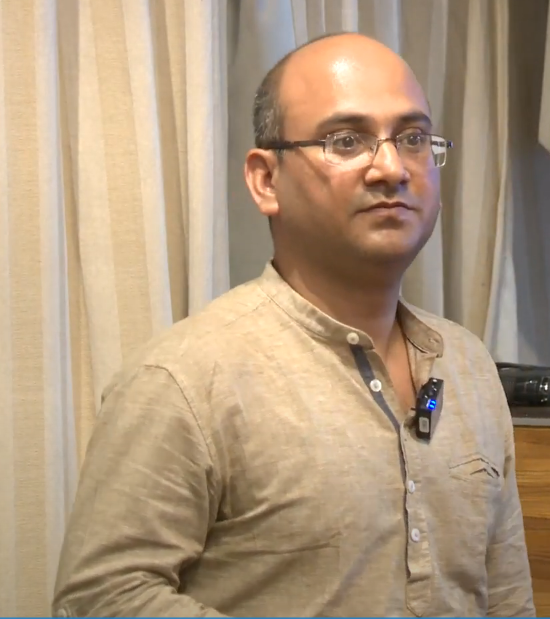
I am Dr. Sarvesh Kumar Yadav, a cosmologist passionate about bridging cutting-edge machine learning techniques with cosmological research. Having recently completed my postdoctoral fellowship at Raman Research Institute where I pioneered neural network-based CMB analysis methods, I am now actively seeking research positions that combine my astrophysics expertise with ML/AI applications.
My current research focus includes:
- Developing ML-enhanced pipelines for CMB component separation
- Applying deep learning to reconstruct primordial B-mode signals
- Creating generative models for cosmological simulations
- Implementing Bayesian neural networks for cosmological parameter estimation
I'm particularly interested in opportunities where I can:
- Expand my machine learning repertoire through collaborative projects
- Apply neural networks to new cosmological datasets
- Develop transferable ML solutions for astrophysical challenges
- Bridge the gap between theoretical cosmology and data science applications
Contact Information
Current Goal:
Seeking research positions at the intersection of cosmology and machine learning
Email:
sarveshkesav@gmail.com
Location:
Prayagraj, India (Remote/Willing to relocate)
Preferred Roles:
• ML Research Scientist (Cosmology)
• Postdoctoral Researcher (Astroinformatics)
• Faculty Positions (Computational Cosmology)
Research Interests
- CMB Component Separation: Develop and improve component separation methods to extract accurate CMB polarization signals for upcoming CMB missions.
- Develop and improve methods to obtain the lensing convergence field (x) map, Sunyaev-Zel'dovich effects, and methods for CMB delensing.
- Non-Gaussianity in CMB maps: Develop a Bayesian method to investigate non-Gaussianity in CMB maps and methods to identify their possible sources.
- Application of machine learning methods to CMB Cosmology: Develop machine learning method for CMB component separation with error quantification.
- Applying state-of-the-art generative models to simulate and study CMB foreground properties for upcoming and future CMB ground and space-based missions.
- Machine learning-based higher-order statistics for cosmological surveys and cross correlation studies.
Education
Ph.D. in Physics
July 2022
Thesis Supervisor: Dr. Rajib Saha
Institution: Indian Institute of Science Education and Research, Bhopal, India
Dissertation title: A model-independent CMB component separation and a non-parametric method to investigate non-Gaussianity in CMB maps
M.Sc. in Physics
July 2013
Indian Institute of Technology, Roorkee, India
- Academic Positions
- Teaching Experience
Academic Positions
Post Doctoral Fellow
December 2022 - December 2024
Mentor: Prof. Tarun Souradeep
Astronomy and Astrophysics, Raman Research Institute, Bangalore, India
Visitor
November 2022
Host: Prof. Tarun Souradeep
Astronomy and Astrophysics, Raman Research Institute, Bangalore, India
Teaching Experience
Teaching Assistant
Fall 2014 - Spring 2018
Courses taught:
- PHY 104 General Physics Lab-II
- PHY 203 General Physics Lab-III
- PHY 103 Physics Lab-I
- PHY 406 Nuclear Laboratory
- PHY 101 Mechanics
- PHY 203X Electrodynamics
Institution: Indian Institute of Science Education and Research, Bhopal, India
Publications
A perceptron based ILC method to obtain accurate CMB B-mode angular power spectrum
Accurate and Unbiased Reconstruction of CMB B Mode using Deep Learning
Investigating non-Gaussianity in CMB temperature maps using spherical harmonic phases
A Bayesian ILC Method for CMB B-mode Posterior Estimation
Improved Diffuse Foreground Subtraction with the ILC Method
- Computational
- Programming
Computational Skills
Software Packages
- HEALPix/Healpy
- CAMB
- Planck Sky Model
- Python Sky Model
- CosmoMC
Machine Learning Packages
- CUDA
- TensorFlow
- KERAS
Programming Languages
- Python
- GNU Data Language (GDL)
- C
- Fortran
Grants & Awards
Research Grant
Project Details: DST SERB NPDF File No.: PDF/2022/002449
Role: Principal Investigator
Program: National Post Doctoral Fellowship (N-PDF)
Title: Investigating blind and artificial neural network-based methods to reconstruct the faint CMB B-modes.
Funding Agency: Science and Engineering Research Board, Department of Science and Technology, Government of India, IN
Project Duration: 2 years, from 14 December 2022 to 13 December 2024.
Honors and Awards
- National Post Doctoral Fellowship, Science and Engineering Research Board, Department of Science and Technology, Government of India, October 2022
- Financial Assistantship for Attending Conferences (FAAC) IISER Bhopal Scheme awarded to attend International Conference, February 2020.
- Rencontres de Moriond Grant, February 2020, awarded to attend 2020 Bi-annual Moriond Cosmology meeting, Italy.
- Financial Assistantship for Attending Conferences (FAAC) IISER Bhopal Scheme awarded to attend National Conference, November 2019.
Talks and Presentations
Invited Talk
- Investigating non-Gaussianity in Cosmic Microwave Background Temperature Maps using Spherical Harmonic Phases, Rencontres de Moriond - Cosmology 2020, April 2020
Contributed Talks
- A machine learning-based method to obtain accurate CMB polarization angular power spectrum, 10th INTERNATIONAL CONFERENCE ON GRAVITATION AND COSMOLOGY: New Horizons and Singularities in Gravity, Indian Institute of Technology Guwahati, India, December 2023
- A Bayesian Neural Network based ILC method to estimate accurate CMB polarization power spectrum over large angular scales, Debating the potential of machine learning in astronomical surveys, ML-IAP/CCA-2023, Dual node IAP (Paris) & CCA/Flatiron (New York), November 2023 (Virtual)
- Non-Gaussianity in CMB temperature maps, Astronomy and Astrophysics, Raman Research Institute, Bengaluru, India, April 2023
- Testing random phase hypothesis in CMB spherical harmonic phases, RRI IN-HOUSE 2023, Raman Research Institute Bengaluru, India, April 2023
- Bayesian ILC Method for CMB B-mode Posterior Estimation and Reconstruction, FRONTIERS IN COSMOLOGY, Raman Research Institute Bengaluru, India, February 2023
- ILC method to extract the CMB signal from the Microwave sky, Astronomy and Astrophysics, Raman Research Institute, Bengaluru, India, November 2022
- A non-parametric method to investigate non-Gaussianity in CMB temperature maps, Department of Physics, Indian Institute of Science Education and Research, Bhopal, India, January 2020
Posters
- A machine learning-based method to detect primordial gravitational wave signature, 42nd Annual Meeting of the Astronomical Society of India, Indian Institute of Science (IISc), Indian Space Research Organisation (ISRO) and Jawaharlal Nehru Planetarium (JNP), Bengaluru India, February 2024
- A Bayesian Internal Linear Combination method for CMB B-mode detection, Frontiers in Cosmology, Raman Research Institute Bengaluru, India, February 2023
- Reconstructing the CMB temperature map using the Internal Linear combination method, Physics Inhouse Symposium, Department of Physics, IISER Bhopal, India, September 2018
- Model Independent method to obtain CMB temperature map, Physics In-house Symposium, Department of Physics, IISER Bhopal, India, October 2015
Conferences and Workshops Attended
- First IAGRG School on Gravitation and Cosmology, (Online), Chennai School of Mathematics, Chennai, TN, India, May 2022
- Cosmoglobe Workshop 2022 (Online), University of Oslo, Oslo, Norway, May 2022
- Cosmoglobe Kickoff Workshop (Online), University of Oslo, Oslo, Norway, June 2021
- Deep Learning for Science School webinar series (Online), Lawrence Berkeley National Laboratory, Berkeley, CA, USA, July-September, 2020
- Physics in-house Symposium, Department of Physics, Indian Institute of Science Education and Research, Bhopal, India, January 2020
- Fourth Paradigm Conference, Department of Electrical Engineering and Computer Science, Indian Institute of Science Education and Research, Bhopal, India, January 2020
- Geometrical and topological Methods for cosmological data analysis, Department of Physics, National Institute of Science Education and Research, Jatni, India, July 2019
- From reionization to large scale structures- a multiwavelength approach, Inter-University Center for Astronomy and Astrophysics, Pune, India, February 2017
- Physics in-house Symposium, Department of Physics, Indian Institute of Science Education and Research, Bhopal, India, September 2018
- Physics in-house Symposium, Department of Physics, Indian Institute of Science Education and Research, Bhopal, India, October 2017
- Global Initiative of Academic Networks (GIAN) workshop on "Dark Matter", Department of Physics, Jawaharlal Nehru University (JNU), India, December 2017
- Workshop on "Introduction to Cosmological Perturbation Theory", Department of Physics, Jamia Milia Islamia University, New Delhi, India, December 2016
- Workshop on "Inflation and Reheating", Department of Physics, Indian Institute of Technology, Madras, India, November 2016
- Physics in-house Symposium, Department of Physics, Indian Institute of Science Education and Research, Bhopal, India, September 2015
Collaborations/Membership
NERSC
I am a user for project Galactic and Extra-Galactic foregrounds (namely the MP107-d repo) at NERSC.
National Supercomputing Mission
I am a user of the national supercomputing facility in India for my research work as a project PI.
CMB Bharat
Active member of CMB Bharat: An Indian Cosmology Consortium dedicated to fostering collaboration and advancing research in the field of cosmology and in particular cosmic microwave background (CMB) cosmology. I have led with the support of other members in initiating a seminar series, where we invite experts in cosmology from around the globe to talk about recent trends in cosmology in particular CMB cosmology.
Journal club at RRI
Member of weekly Journal club, Very Sirius Meeting (VSM) organised every Tuesday afternoon in Department of Astronomy and Astrophysics, Raman Research Institute.
Journal club at IISER Bhopal
Was founding member of weekly Journal club, Physics Studio, organised on Friday evenings, in the Department of Physics, Indian Institute of Science Education and Research, Bhopal.
Outreach Activities
National Science Day Outreach
Demonstrated simple science experiments to school children as a volunteer for National Science Day at the Raman Research Institute, 28, February 2024.
Public Science Outreach
Participated as a team member of the Raman Research Institute team at the India International Science Festival (IISF) 2024. We explained to the general public and school children, the research at the RRI in very simple language. We also received the "Best Conceptual Pavilion Award", 17-20, January 2024.